Murray's public call for New English Dictionary quotations
The Surgeon of CrowthorneJames Murray’s 1879 appeal asked the English-reading public to help build the New English Dictionary by reading books and extracting illustrative quotations. More than a request for assistance, it opened the project’s work to readers beyond its editorial rooms: copies circulated through newspapers, shops and libraries, and one eventually reached William Chester Minor in Broadmoor Criminal Lunatic Asylum. The invitation gave an isolated, book-loving inmate a practical role in a national scholarly undertaking, while the contributions that followed showed how volunteer reading could be organized into a working resource for editors.
The project behind the appeal
On 1 March 1879, after a year of contract negotiations, Murray formally undertook to edit the New English Dictionary on Historical Principles for the Philological Society. Its proposed scale was already formidable: an estimated 7,000 quarto pages in four volumes, to be completed in ten years. That estimate would prove far too modest, but the agreement marked the point at which the work was properly under way.
Within days, Murray made two decisions that joined the physical work of editing to the recruitment of readers. He would build a corrugated-iron shed in the grounds of Mill Hill School and call it the Scriptorium; he would also publish a four-page appeal seeking a fresh body of volunteers. The dictionary depended on reading and extracting material from books that had not yet been examined. Murray’s request therefore extended work already enthusiastically begun some twenty years earlier, rather than proposing an entirely new undertaking.
The appeal described a task that was both broad and concrete: readers in Great Britain, America and the British colonies were wanted to read remaining books and record useful extracts. The scale of the dictionary could not be met by editorial expertise alone. It required a distributed workforce, each reader turning encounters with words in books into evidence that could be sent on for consideration.
Circulation beyond the editorial rooms
The appeal travelled through several overlapping channels. Newspapers and magazines treated it as a press release and printed whichever passages seemed likely to interest their readers. Copies also went to bookshops and newsstands, where assistants handed them to customers; librarians used them as bookmarks; and small wooden cases in shops and libraries allowed members of the public to take one and read it. The text thus reached prospective volunteers in places where books were already being sold, borrowed or browsed, rather than remaining an internal notice addressed only to scholars.
These ordinary means of circulation gave the appeal an unusually wide reach around the kingdom and its dominions. Its distribution also made the project’s practical needs visible: readers were not merely invited to admire the ambition of a dictionary but asked to take part in the labor of making one. The Scriptorium and the appeal answered complementary problems. One gave the editor a base from which to organize the work; the other sought readers whose extracts could feed it.
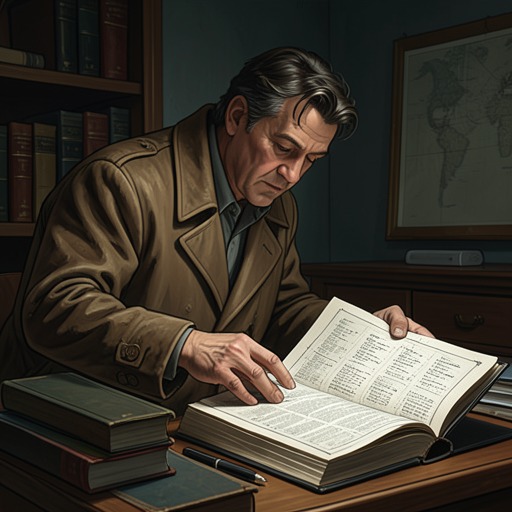
The appeal’s most consequential known journey took it to Crowthorne. Sometime in the early 1880s, at least one copy, left in a book or tucked inside a learned journal, reached a cell on the top floor of Block 2 at Broadmoor Criminal Lunatic Asylum. Minor had been an inmate there for eight years. His two cells included a room lined with books from floor to ceiling, and reading had become a central part of his life. The appeal offered not simply more material to read, but a defined task that could occupy the long period of confinement before him. He wrote to Murray immediately.
From invitation to an editorial resource
Minor’s response developed into a distinctive form of volunteer work. Rather than only reading assigned books and sending quotations as he encountered them, he assembled word lists and indexes while he read. By the autumn of 1884, his collection was large enough for him to ask Murray and the other editors which catchwords they needed. He could then search his accumulated notes for words at the moment the dictionary required them.
The method made his reading available on demand. Minor first asked which letter or word the editors were working on; when they replied, he checked his indexed lists, returned to the relevant pages in his books, copied a suitable sentence onto a quotation slip and sent it to the Scriptorium. His papers amounted to a personal index system—a dictionary within the dictionary—that linked books, page references, requested words and citations. The editors could ask for a troublesome word instead of searching their own shelves and accumulated slips in the hope that a useful quotation already existed.
The first test of this arrangement concerned the word art, which was due for the second fascicle, then being prepared for publication in 1885. After an appeal for further and earlier meanings, eighteen readers replied following an article in the Athenaeum. Minor’s contribution stood apart: he sent twenty-seven quotations, while the other replies offered only a sentence or two. Many of his examples came from Joshua Reynolds’s Discourses, but they were valuable evidence for the dictionary, and one became the first known quotation he placed in the completed work. The episode made the promise of the public call tangible: an invitation circulated among ordinary reading places could produce precise, usable material for a difficult editorial problem.
A collaborative system, not a solitary achievement
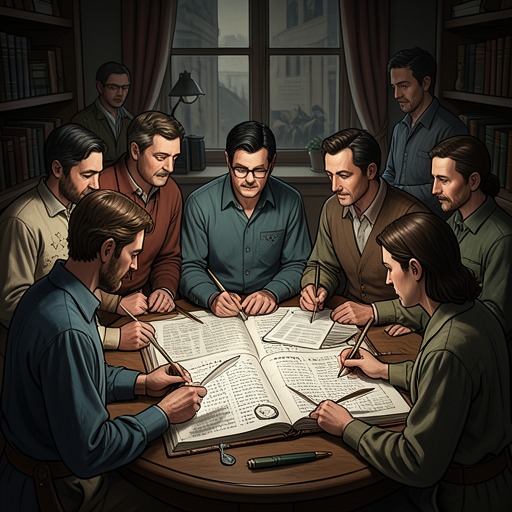
The appeal’s effects belonged to a wider system of readers, correspondence, sorting and editorial judgment. At the Scriptorium, incoming bundles were checked for completeness and spelling, divided alphabetically and by part of speech, and arranged chronologically before assistants examined changes in meaning and worked on definitions. Murray organized this process with a large staff, including children from his family who sorted catchwords. A volunteer’s quotation was therefore not the finished dictionary entry: it entered a sequence of checks and decisions through which evidence could be compared, ordered and used.
Minor’s system was especially useful because it let the editors request material for words they needed, but its usefulness depended on the connection established by the appeal and sustained by letters to and from Crowthorne. His contribution was neither the product of an isolated genius nor a substitute for the project’s collective labor. It was a specialized form of reading made valuable by an editorial network capable of requesting, receiving and processing it.
Murray eventually met Minor in January 1891, after writing for permission to visit him. The two had already corresponded for years; their meeting began a personal friendship grounded in mutual respect and a shared interest in words. In this light, the public appeal stands at the start of both a practical working relationship and a longer human connection. Its significance lies in how a printed request crossed the distance between the Scriptorium and a locked cell, turning an invitation to read into sustained participation in the making of the dictionary.